

KNOW YOUR RIGHTS
ON THIS PAGE
STATEMENTS FROM TRANS RIGHTS ATTORNEY AND EXPERT SIMONE CHRISS, DIRECTOR OF THE TRANSGENDER RIGHTS INITIATIVE AT SOUTHERN LEGAL COUNSEL
In this section, you can find the most recent guidance issued by the leading trans rights attorney in Florida on all of the issues impacting trans folks and parents of trans youth in Florida and nationwide.
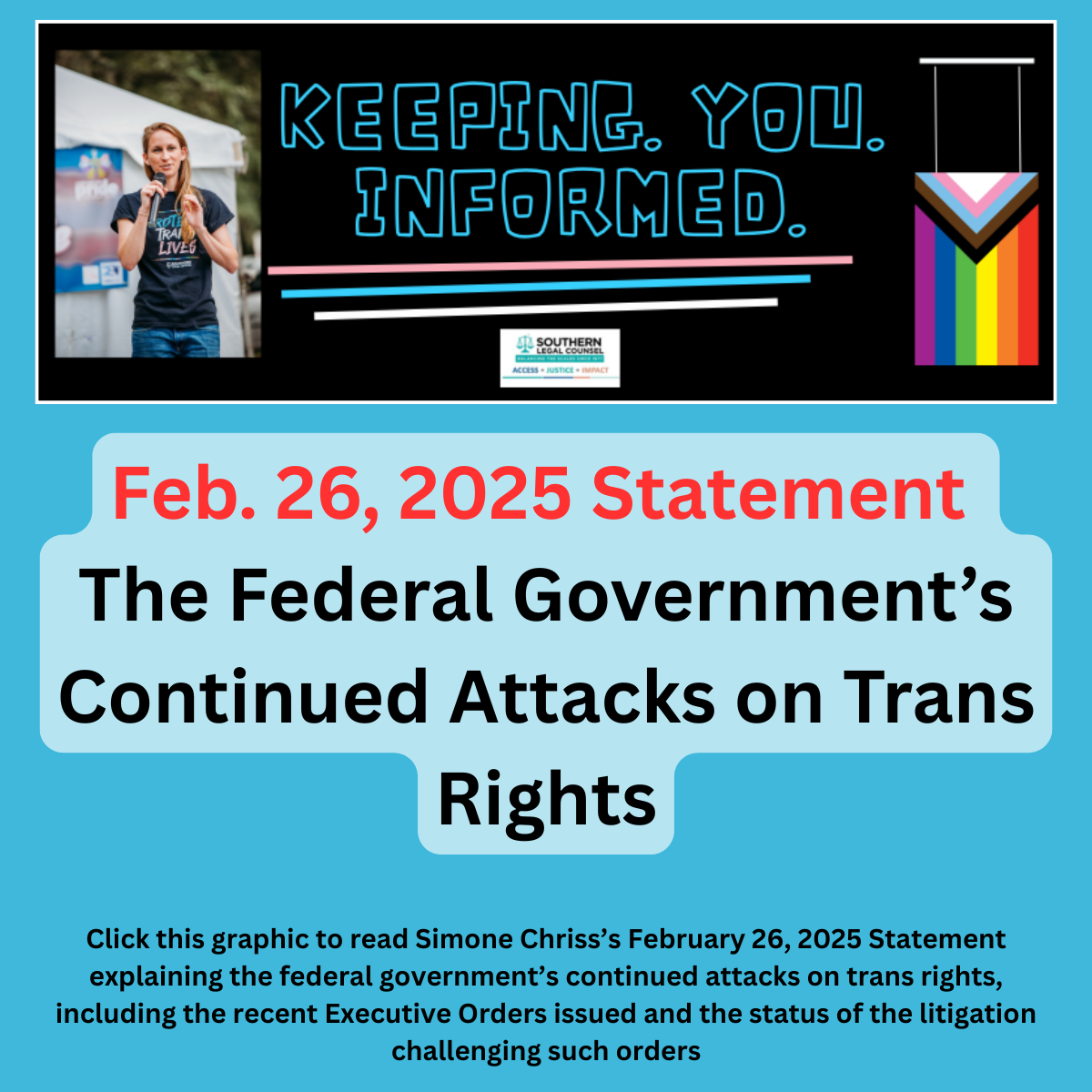
She breaks down the Trump administrations’ cruel Executive Orders targeting trans folks, the state’s continued efforts to legally erase trans Floridians, the status of the lawsuits challenging these discriminatory measures, and more!
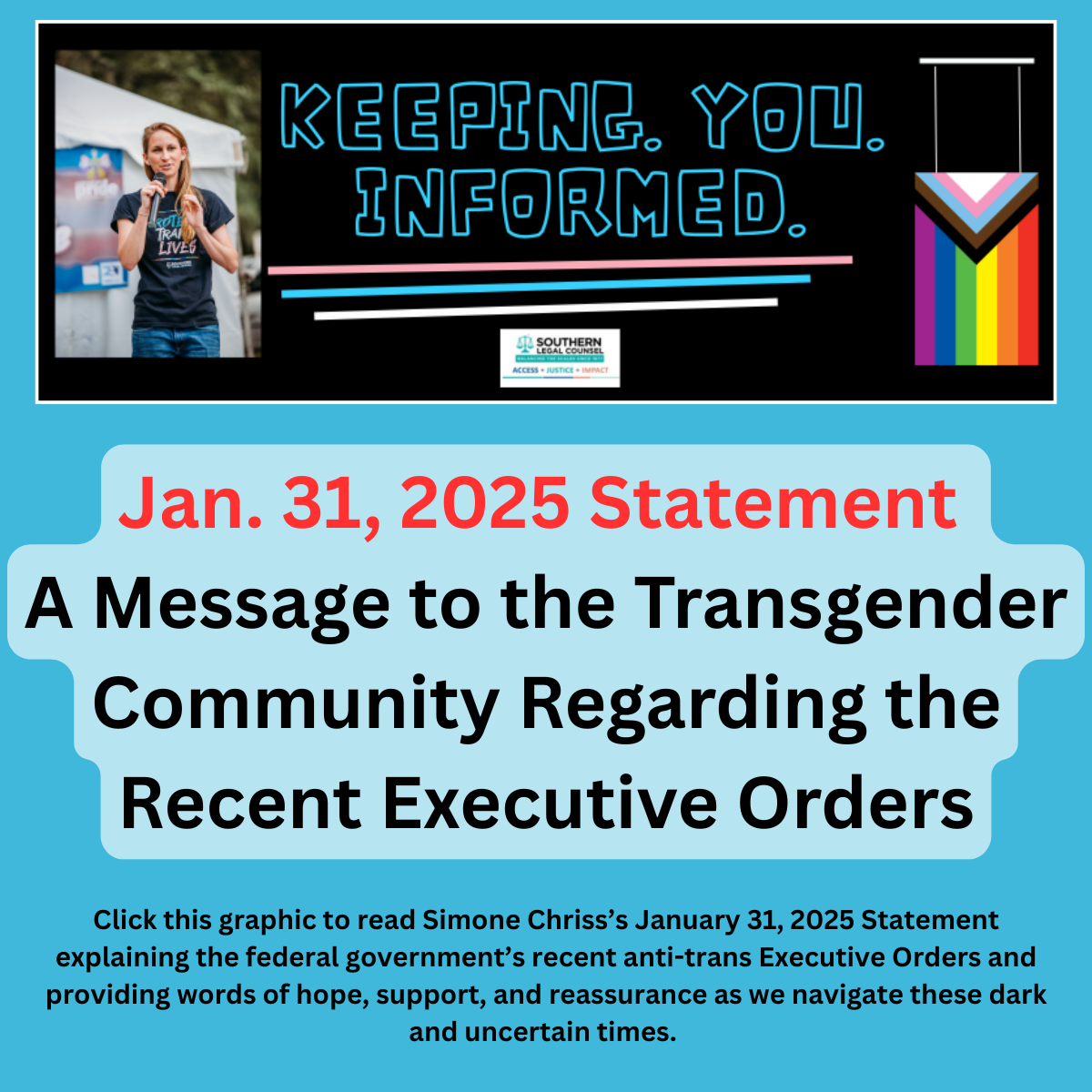
To read the full text of each of the statements below, click on the graphic and the statement will open in another window.
Know Your Rights: Access to Gender-Affirming Healthcare in Florida
RECENT UPDATE:
AS OF AUGUST 2024:
The 11th Circuit Court of Appeals issued a Stay in the Doe v. Ladapo case, which means the law and rules are able to be enforced again by the state as the appeal moves forward.
Anyone who is unable to access care in the state of Florida can still obtain gender-affirming care in any state without a ban, including through the trusted provider, QueerMed. Visit queermed.com for more information on accessing care out-of-state!
Downloads:
Doe v Ladapo Order (ECF 224), which was litigated by:
Southern Legal Counsel
GLBTQ Legal Advocates & Defenders
National Center for Lesbian Rights
Human Rights Campaign
Lowenstein Sandler LLP
Doe v. Ladapo Press release, explaining more about the order.
Can Trans Floridians Access Gender-Affirming Care in Florida?
SLC and partners challenged the discriminatory law and rules banning gender-affirming care for trans minors in Florida and restricting access to care for trans adults. After an extensive trial in our class action, Doe v. Ladapo, we successfully obtained a permanent injunction blocking enforcement of SB 265 and the Boards of Medicine Rules and restored access to gender-affirming care for all Floridians.
On June 11, 2024, a federal court struck down SB 254 and the Florida Boards of Medicine rules. Judge Hinkle issued a permanent injunction blocking enforcement of Florida’s ban on healthcare for transgender minors and the restrictions for transgender adults. This order in Doe v. Ladapo restored access to gender-affirming medical care for ALL transgender Floridians (adults and minors).
The Final Order (ECF 224) declared Florida’s SB 254 and the Florida Board of Medicine Rules (including the informed consent forms) to be unconstitutional.
READ THE DOE v. LADAPO PRESS RELEASE HERE.
This order means that healthcare providers throughout Florida may provide medically necessary gender-affirming care to transgender youth and adults without being subject to professional discipline or criminal/civil penalties.
The ruling in Doe v. Ladapo found that Florida SB 254 and the related Boards of Medicine (BOM) rules were motivated by animus, bias, and disapproval of transgender people and that they violate the equal protection rights of transgender individuals and parents of transgender minors in Florida. Florida was the first state to pass a law restricting access to gender-affirming healthcare for transgender adults. The Order permanently blocks those restrictions, as well as the bans on care for adolescents, which the Court preliminarily blocked last June.
WHAT THIS MEANS:
Transgender adolescents can receive puberty blocking medications and cross-sex hormones if they are deemed medically necessary for the treatment of their gender dysphoria (as decision-making has been placed back in the hands of the parents, the doctor, and the patient, as opposed to the state!)
Transgender adults can receive the gender-affirming healthcare they need without unnecessary restrictions; for example they can obtain their care from an NP or APRN (non-physicians), which was previously prohibited by law under SB 254. Transgender adults can resume care with their trusted providers, i.e. Spektrum Health, Planned Parenthood, and other non-physician providers.
The discriminatory “informed consent” forms can no longer be required by the state (or by providers) and have been declared to be unconstitutional and invalid.
In person informed-consent is still required to be obtained from providers before prescribing a new gender-affirming medication (blockers or cross-sex hormones for minors and adults) or gender-affirming surgery (for adults), but there is no specific form that is required, and visits after the initial prescription of a new medication can be conducted through telehealth.
Physicians (MDs and DOs) cannot be penalized through civil or criminal means for prescribing gender-affirming care to minors, and APRNs/NPs cannot be penalized through civil or criminal means for prescribing gender-affirming care to adults.
The medically unnecessary requirements contained in the Florida Boards of Medicine Emergency Rules have been struck down and are no longer enforceable, including:
annual hand x-rays;
annual DEXA scans;
requiring the mandatory annual mental-health assessment to be conducted only by a licensed psychiatrist and psychologist rather than another licensed mental-health professional;
in-person physician visits every six months;
suicide assessments by a licensed mental-health professional every three months; and
laboratory testing every four months.
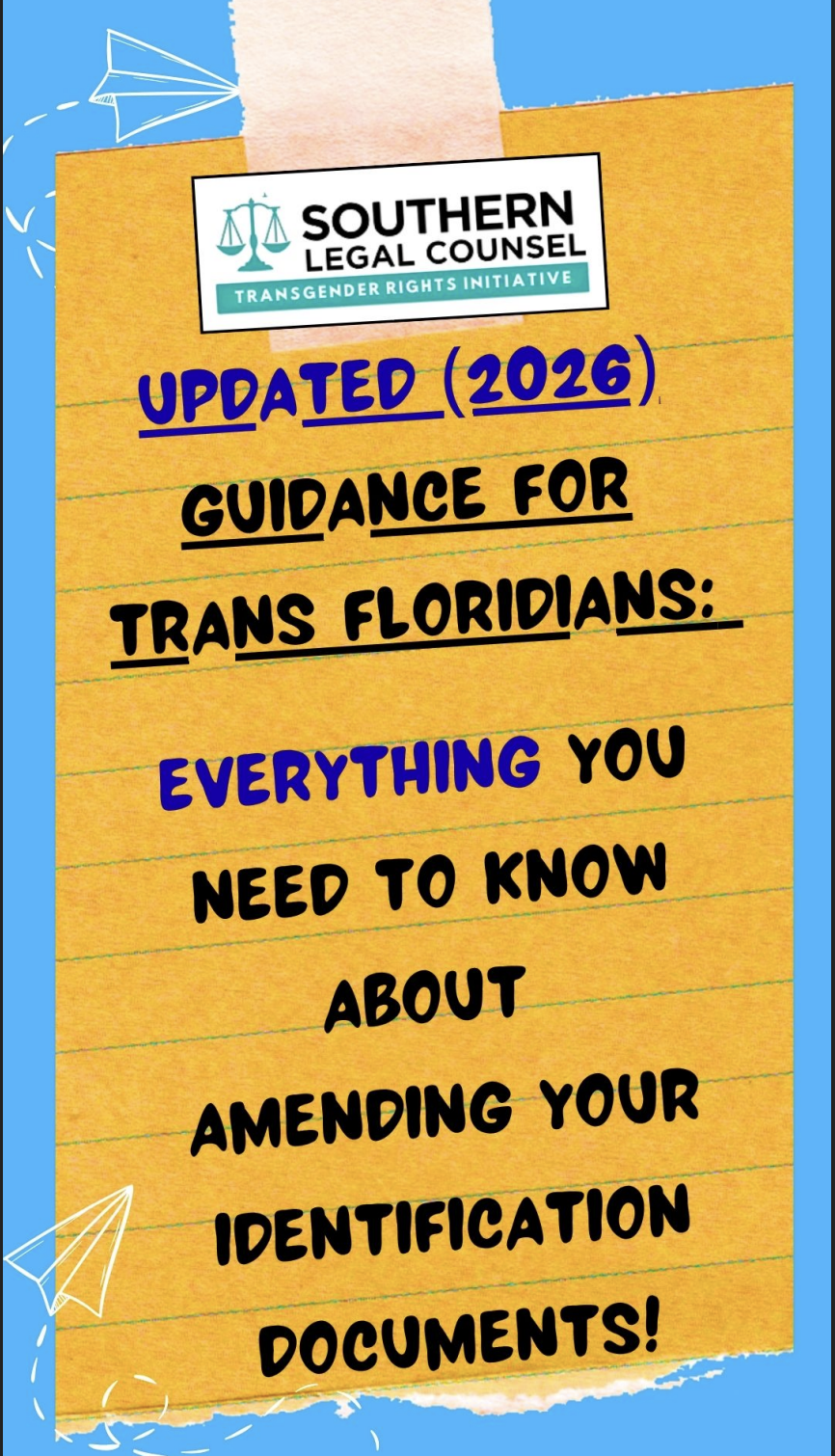
Know Your Rights: Access to Florida Licenses/IDs Under the FLHSMV’s New “Policy”
What Happened:
The Florida DHSMV (FLHSMV) changed their policy regarding gender marker changes on Florida driver licenses and IDs. Attorney Simone Chriss put out a memorandum (see below) to clarify the scope and impact of FLHSMV’s new “policy” to ensure all transgender Floridians and advocates/allies know their rights!
Downloads:
Clarifying the FLHSMV’s New “Policy” by Simone Chriss, Esq., Director of the Transgender Rights Initiative at Southern Legal Counsel
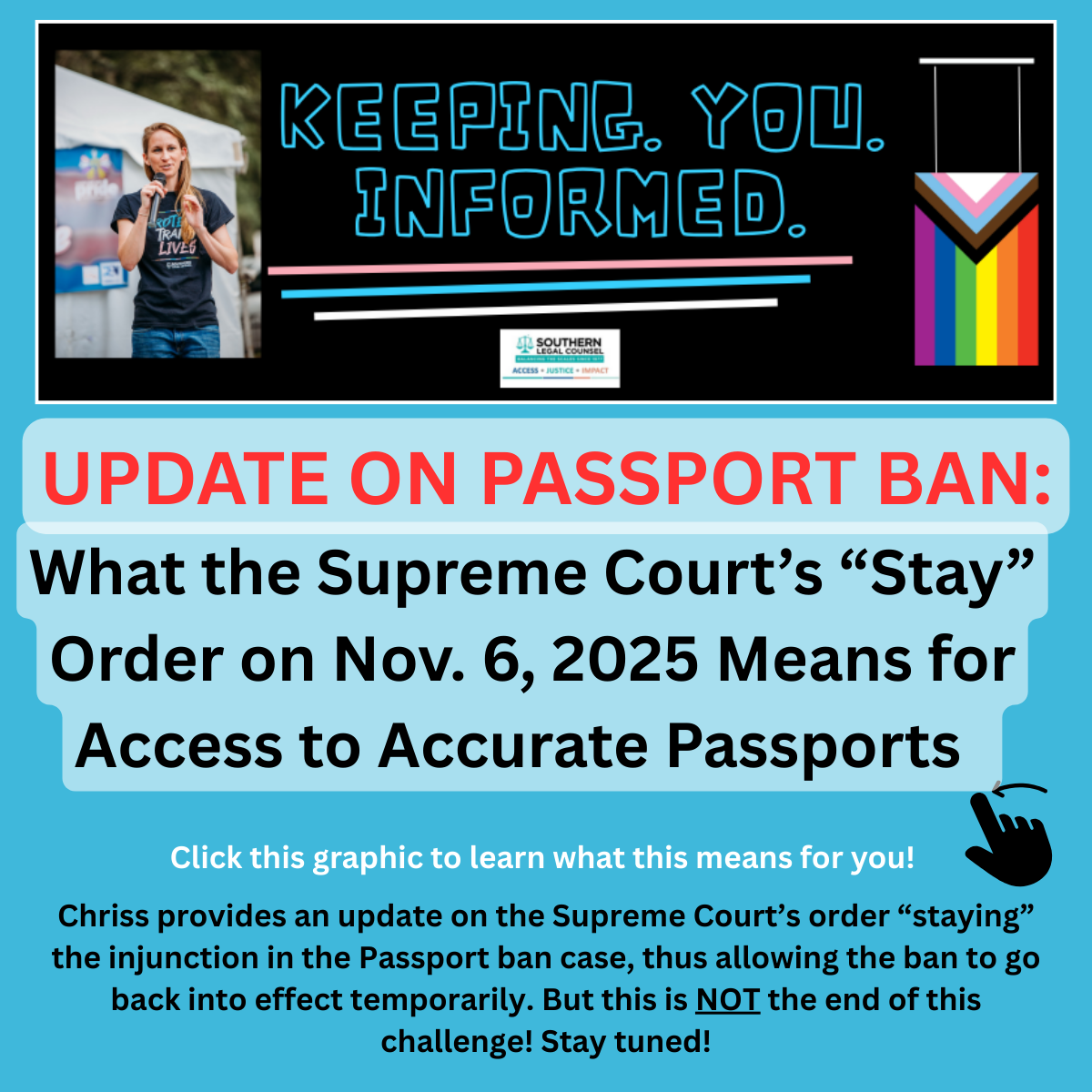
UPDATED GUIDANCE ON Passport Ban (currently, Passports cannot be amended, and thus for anyone who doesn’t already have an accurate passport, they cannot use their passport to obtain an amended Driver’s License/ID).
Big Picture Overview:
The Florida Department of Highway Safety and Motor Vehicle (FLHSMV) rescinded the guidance that directed DMV staff and Tax Collectors to amend gender markers on Florida licenses and IDs when a person presented a gender marker letter from their medical provider.
The new guidance states that a person’s “gender as displayed on the driver license or identification card must be taken from a primary identification document.”
Note: U.S. Passports and birth certificates are both primary identification documents under the FLHSMV’s own definition, so anyone who has an accurate birth certificate OR passport reflecting the correct gender marker can request a Florida drivers license/ID matching that gender marker.
According to the FLHSMV, this policy change regarding gender markers only applies to replacement licenses (i.e. people seeking to change the gender marker on their license or ID), not newly issued licenses (i.e. first time permits, licenses or IDs) or renewals (i.e. not making a change, simply renewing when expires). This is because they say Florida law only permits them to issue replacement licenses “when a license or permit is lost or stolen, or when there is a subsequent change in the licensee’s name, address, or restrictions” (as such, gender marker change does not qualify).
Based on the statutes that the FLHSMV’s memorandum relied upon when discussing penalties and enforcement authority, there is no reason to believe that any transgender person in Florida who has a lawfully issued, valid (non-expired) Florida driver license or ID that was issued prior to January 26, 2024 will have their document suspended, revoked, or will face any criminal penalties; nor should these folks have their driver’s licenses reverted to reflect their sex assigned at birth. Rather, the discriminatory new policy just prevents individuals with Florida driver licenses and IDs that reflect their sex assigned at birth from amending their document to reflect their gender identity.
There have been many folks who amended the gender marker on their drivers license or ID after January 26, 2024 who have received a replacement license in the mail reflecting their sex assigned at birth and a letter from the FLHSMV explaining that the amendment of their gender marker was a mistake. There is currently no appeals process for this, nor any legal remedy to pursue at this time, but Simone Chriss at Southern Legal Counsel is working on ways to ensure folks have accurate and affirming IDs.
Know Your Rights - How to Access Accurate Legal Documents:
Obtaining a first-time Florida license, permit, or ID? You can obtain a first-time license, permit, or ID reflecting your correct gender marker (aligned with your gender identity) as long as you bring a primary identification document that reflects your gender identity. If you have an updated birth certificate or an updated Passport (reflecting your affirmed gender marker), you can use that as your primary identification document and obtain a first-time license or ID reflecting the correct gender marker. This only applies to folks who have never had a Florida license, permit, or ID before.
Renewing a Florida license, permit, or ID that was amended to reflect your gender identity? You should have no trouble, as the new “policy” does not impact renewals, only replacements (i.e. seeking to amend the gender marker on an existing license, permit, or ID that currently reflects your sex assigned at birth)
Amending a Florida license, permit or ID? Under the current policy, you will likely be unable to amend your existing license, permit, or ID to reflect your gender identity, but if you have a U.S. Passport reflecting your correct gender marker, you can use that instead of your Florida license/ID in all instances where government-issued identification is required (other than instances where a driver’s license is specifically required, such as a traffic stop). Civil rights attorneys, including our Board Chair, are working to challenge this new policy and restore to all transgender Floridians the right to access accurate, authentic Florida identification documents.
Know Your Rights: Parents of LGBTQ+ Students
(“Back to School” Handbook)
Timeline of Anti-LGBTQ+ laws and policies in Florida Schools:
July 1, 2021 - HB 241 / FL Statute 1014, known as the “Parents’ Bill of Rights”
July 1, 2022 - HB 1557 / FL Statute 1001.42(8)(c), known as the “Don’t Say Gay/Trans” law
November 18, 2022 - Letters from FL Dept of Education to School Districts, leads to rescinding or amending of LGBTQ+ Critical Support Guides
May 17, 2023 - HB 1069 known as the “Don’t Say Gay/Trans Expansion” law was signed into law
May 17, 2023 - HB 1521 known as the “Bathroom Ban” was signed into law
Downloads:
Parents of LGBTQ+ Youth, Know Your Rights Handout from Attorney Simone Chriss, Director of the Transgender Rights Initiative at Southern Legal Counsel
FERPA (Family Educational Rights and Privacy Act) Suggested Pronoun Request Letter from Attorney Simone Chriss, Director of the Transgender Rights Initiative at Southern Legal Counsel
Your student has the right to:
a safe and affirming learning environment
use, and consistently be addressed with, affirmed name and pronouns
freedom of speech and expression
access sex-segregated spaces, including bathrooms and locker rooms, that feel safe and affirming for your student
privacy, including informational privacy and bodily autonomy
How to prepare for the start of the new school year:
STEP 1
Prior to August 1st, set up a meeting with your child’s school principal and / or other administration and leadership to discuss a plan to ensure a successful and affirming school year.
If the meeting request is made over the phone, make sure to follow up and confirm in writing.
STEP 2
Prepare a list ahead of the meeting outlining what the school can do to create a safe and affirming environment for your child, knowing which legal rights and protections support those requests.
Ensure that any necessary information is conveyed to the individuals who will be in contact with your child.
STEP 3
After the meeting, follow up in writing with the school and district providing a summary of what was discussed and agreed to (or not agreed to).
Put everything in writing in case issues arise in the future.
STEP 4
If the school refuses to comply with the reasonable requests made, reach out to Southern Legal Counsel or Equality Florida for assistance.
Examples: refusing to ensure consistent use of affirmed name and pronouns, denying access to a bathroom that feels safe for your child, fails to treat your child in accordance with their gender identity at school, etc.
Your child’s rights under the IDEA and Section 504 of the Rehabilitation Act
REQUEST AN ASSESSMENT for qualification for an IEP or 504 Plan as conducted by an assessor who is culturally competent in LGBTQ+ issues. [20 U.S.C. § 1414(b)(3)(A)(1)]
Once eligibility for services is determined, REQUEST A MEETING WITH THE SCHOOL and DEVELOP THE PLAN to ensure appropirate supports and accommodations are in place.
NOTE: Accommodations can include consistent use of affirmed name and pronouns, access to bathrooms, stress breaks, designating an affirming teacher as the go-to support person, etc.
The Sources of LGBTQ+ Students’ Rights:
Title IX of the Education Amendments of 1972
Family Education Rights and Privacy Act (FERPA)
Equal Protection Clause of the 14th Amendment to the United States Constitution
First Amendment to the United States Constitution
Equal Access Act of 1984
Florida’s “Parents’ Bill of Rights” - § 1014.01-1014.06, FL Satute (2021)
Key Terminology to assist with advocating for an affirming school environment:
“Sex assigned at birth” refers to the designation on your birth certificate, typically determined by a doctor, based on an assessment of external genitalia. However, each individual’s sex is multifaceted and is comprised of many distinct biological characteristics, including (but not limited to): chromosomal makeup, hormones, internal and external reproductive organs, secondary sex characteristics, and gender identity.
“Gender identity” refers to your internal understanding of your gender. Everyone has gender identity. It is durable and cannot be changed by social or medical intervention.
“Gender expression” refers to the way that we express our gender to others, including through clothing, hair style, mannerisms, etc.
“Sexual orientation” refers to who we are attracted to, including physically, emotionally, romantically, etc.
“Transgender” is an umbrella term used to describe people whose sex assigned at birth does not align with their gender identity.
Ensuring your child has access to a non-discriminatory, safe, and affirming school environment
LEGAL PROTECTIONS SUPPORTING YOUR REQUEST:
Title IX prohibits discrimination “on the basis of sex” in “any education program or activity” that receives federal funding [20 U.S.C. Section 1681(a)], which includes discrimination against LGBTQ+ students, who must be provided “equal access to educational programs and activities.”
The Equal Protection Clause of the U.S. Constitution laws imposes a duty on schools to treat LGBTQ+ students equally, and school policies that classify students on the basis of sex are presumptively unconstitutional.
The First Amendment of the U.S. Constitution protects students’ fundamental rights to engage in constitutionally protected speech related to LGBTQ+ issues, and their right to receive information and ideas related to sexual orientation and gender identity. It also guarantees freedom of expression, including expressing their sexual orientation or gender identity.
Under Florida’s “Parents’ Bill of Rights” (FL Statute Chapter 1014), parents of LGBTQ+ students have the fundamental right to “direct the upbringing, education, and care of their minor children,” and to do so free from “obstruction or interference” from the state, school district, or school.
The Equal Access Act requires schools / districts to allow GSAs / LGBTQ+ student groups if the school permits any other non-curricular student group.
POTENTIAL OBSTACLES TO YOUR REQUEST:
HB 1557 and HB 1069, known as the “Don’t Say LGBTQ+” laws, along with the related rules promulgated by FLDOE, were designed to remove LGBTQ+ discussions, curriculum, books, teachers, and more from Florida schools.
HOWEVER, these state laws use ambiguous, vague, and undefined terms, and they violate federal law.
Further, the State itself has made clear in legal pleadings defending against the challenges to the “Don’t Say LGBTQ” law that there is no impact on anything other than direct classroom “instruction,” so these laws cannot be weaponized to prohibit LGBTQ+ discussions, safe- space stickers, inclusive books, participation in GSAs / LGBTQ+ student groups, nor intervention in anti-LGBTQ+ bullying.
Ensuring consistent use of your child’s affirmed name and pronouns at school
LEGAL PROTECTIONS SUPPORTING YOUR REQUEST:
The Family Education Rights and Privacy Act (FERPA) protects the personal information of students in their school records, prohibits the sharing of information without permission of the students or their parents, and gives parents the right to request that the school amend their child’s legal name and / or sex assigned at birth on their education records in order to ensure that the records do not violate their child’s privacy rights (i.e. “outing” the student without consent) [20 U.S.C. § 1232g; 34 C.F.R. §§ 99.00 et seq.]
In addition to FERPA, both Title IX and the Equal Protection Clause provide legal protections as well.
POTENTIAL OBSTACLES TO YOUR REQUEST:
HB1069 (also known as the “Don’t Say LGBTQ+ Expansion” bill) was recently enacted and allows teachers, staff, and students to disrespect a person’s pronouns if the pronouns do not correspond to their sex assigned at birth.
This just means that schools cannot require teachers and students to use and respect the pronouns that align with your child’s gender identity, but it does not prohibit them from using your child’s affirmed pronouns.
Federal law requires them to do so, and you can file a Title IX or FERPA complaint if necessary.
Potential support from FLDOE Rule: The Florida Department of Education is promulgating a rule [6A-1.0955, “Education Records”] that requires schools to adopt provisions and forms to allow parents to specify “the use of any deviation from their child’s legal name in school”. The purpose is the “protect parental rights,” and this includes the rights of parents of transgender youth to ensure their child’s affirmed name is used and respected consistently at school.
Ensuring your child has access to bathrooms and sex-segregated spaces that feel safe and affirming at school
LEGAL PROTECTIONS SUPPORTING YOUR REQUEST:
Title IX and the Equal Protection Clause prohibit discrimination on the basis of sex in schools, which includes discrimination based on sexual orientation or gender identity. Nearly every federal court to weigh in on the issue has concluded that excluding transgender youth from the bathroom that aligns with their gender identity violates Title IX and the Equal Protection Clause.
The U.S. Department of Education’s Office of Civil Rights is responsible for protecting the rights of all students, including through enforcement of Title IX against schools that are engaging in impermissible discrimination against LGBTQ+ students.
POTENTIAL OBSTACLES TO YOUR REQUEST:
Recently enacted HB1521 (also known as the “Bathroom Ban”) allows for discriminatory measures related to use of bathrooms and changing rooms, but it does not require that schools discriminate when it comes to sex-segregated spaces.
Rather, the law requires that a school have either:
(1) a restroom and changing room designated for exclusive use by people whose sex assigned at birth was female, and a restroom and changing room designated for exclusive use by people whose sex assigned at birth was male
OR(2) a unisex bathroom and changing room (i.e. single-user space with floor to ceiling walls and a door that locks)
Schools must also establish a disciplinary procedure within its code of conduct for IF a transgender student refuses to leave a bathroom not aligned with their sex assigned at birth AFTER being asked to do so, but they do not have to submit documentation regarding compliance until April 1, 2024, and the Attorney General cannot enforce these requirements against school districts until July 1, 2024.
Status of Florida Birth Certificate Amendments:
In 2023, the Florida Department of Health (FDOH) decided to stop amending gender markers on Florida birth certificates. This is because the FDOH (and Bureau of Vital Statistics) changed their interpretation of a Florida rule and statute that previously allowed people to amend their gender markers on their Florida birth certificates, and the agency is now denying all applications to amend gender markers.
We are litigating against this discriminatory policy in federal court, but in the meantime, you can use a U.S. Passport instead of a Florida birth certificate in most instances, so make sure you have amended your (or your minor child’s) U.S. Passport to reflect the correct name and gender marker - this provides important legal protection!
Know Your Rights:
You can still amend the legal name on your Florida birth certificate, just not the gender marker (for the time being).
If you were born in a state other than Florida, you can find the process for amending your birth certificate in that state using this website and clicking on your state of birth.
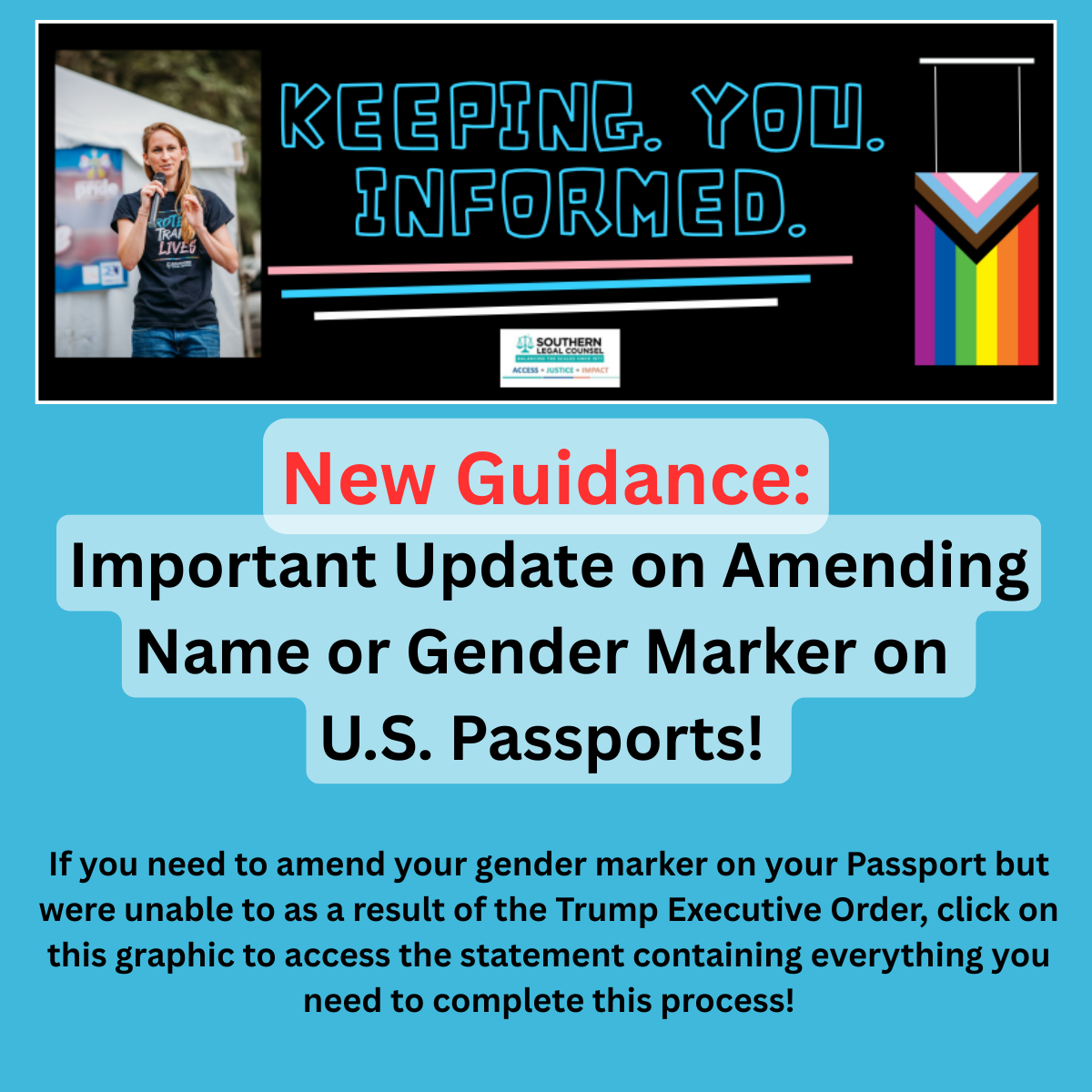
If you have not yet done so, you should obtain a U.S. Passport or amend your current U.S. Passport to reflect your new legal name and affirmed gender marker (the gender marker aligned with your gender identity), as a U.S. Passport is a primary identification document and can be used in nearly all instances instead of a birth certificate.
Helpful guidance detailing the process for amending the name and gender marker on your U.S. Passport (including links to the forms you need) can be found here!
You should amend the legal name on your Social Security record, and the process for doing so can be found here.
For information about amending name and gender markers on Florida driver licenses, permits, and state ID’s, see section above.
Subscribe for Updates
Sign up with your email address to receive news and updates.